A very special quilt pattern turns 89 today.

Here’s the pattern. It was published in the Kansas City Star on August 31, 1932.

What makes this pattern special? My grandma designed it…when she was 12. She sent it in to the Kansas City Star newspaper, who published it in their weekly quilt pattern series. Not knowing her age, they attributed it to her with ‘Mrs.’ before her name. That famous KC Star quilt series ran from 1928 to 1961. You can read more about it here. More information and a partial list of all of the KC Star patterns can be found here.

In 1986, the KC Star did a feature page on their quilt series, featuring The Purple Cross in their images.

Here is how the Purple Cross block can look in various quilt configurations. The diamond configuration was the first one I made. That is me and Grandma holding it.

Here’s a close-up of a kaleidoscope block.

Myrtle the dog stresses the importance of testing works in progress, and proper use of finished quilts.

This was the grandma who taught me to sew really well, on her dream machine, the Singer 401a Slant-O-Matic, that I now have care of, until it’s time to pass it on to the next generation.

The Purple Cross pattern is difficult. It starts out easy, when making the stars. But when you add the circle inserts it gets more complicated, and then the corners make it even more difficult. And then when sewing the blocks together I literally almost give up completely, feeling like I really don’t know how to sew at all! It would be slightly easier to construct if sashing strips are added between the blocks. As you can see from the examples above, I haven’t done that. I like the look of the blocks right next to each other.

So anyway, Happy Birthday to Grandma’s Purple Cross Quilt Pattern! Looking forward to making more of these quilts.


And now for some music!

The Slicethelife.com song draft continues, and is now on Round 5. The Run-Sew-Read.com round 5 selection will be this weekend. What will it be? I’m still deciding. A listing of the songs in the first four rounds can be viewed here.

For Round 4 I went for fun and ornery. Here’s the post, and below the song and video. http://slicethelife.com/2021/08/22/2021-song-draft-round-4-pick-7-run-sew-read-selects-half-a-boy-half-a-man-nick-lowe/

If you plant it they will come (Monarch Butterflies)

August is the season of the annual butterfly invasion of my back yard.

I’m not responsible for it. The Chasteberry bush was in my yard when I moved here almost 2 decades ago. It grows big and wide (8-10 feet tall and wide), it’s not pretty, and smells terrible. It actually gives me a headache when I trim it, i.e., a mild allergic reaction. But I put up with it just so I can enjoy these scenes in August. It’s like a busy airport for monarchs and other butterflies and bees.

When I started hearing about monarch butterfly numbers diminishing a few years ago, I thought it was a story concocted to advance a political agenda. The monarchs had never let up on their visits to my yard, and it never occurred to me that things were different elsewhere. It’s the bush. It brings all sorts of butterflies and bees.

Each year late in the fall after there’s been a freeze, I cut the bush down to the ground, and reclaim that corner of my yard. Then every summer the bush grows back with a vengeance, and then in August the Monarchs return to frolic with each other, do touch-and-goes, and feast on the purple flowers.

The Chasteberry has potential medicinal properties. I can’t speak to those properties with any authority, but the aroma and it’s power to give me a headache makes me not doubt its potential. The National Institute of Health has a page on the Chasteberry. https://www.nccih.nih.gov/health/chasteberry

The Chasteberry has similarities in appearance to the more well known ‘Butterfly Bush’, aka, Buddleia. However, the Buddleia grows into a smaller, more compact bush, with a fuller purple flower than the Chasteberry. The Buddleia bush might be a more visually pleasing option for a front yard. Like the Chasteberry, the Buddleia also looks easy to grow, to the point of being a challenge to contain.

The Farmer’s Almanac has a page on the Buddleia bush and other butterfly attracting plants. https://www.almanac.com/plant/butterfly-bush

If a big bush isn’t right for your space, Zinnias attract butterflies too, are super easy to grow, and look pretty through the window.

And because there’s no such thing as too many butterfly pictures:


Checking in on the Song Draft over on Slicethelife.com, we are now on Round 3. Here’s the awesome playlist from the first three rounds. https://slicethelife.com/2021/08/15/2021-song-draft-recap-rounds-1-3/

The latest Run|Sew|Read pick goes back to music my teenage parents grooved to before I was born: http://slicethelife.com/2021/08/09/2021-song-draft-round-3-pick-8-run-sew-read-selects-apache-the-shadows/

And for the synchronised guitar dance moves:

I click on the numbered list every time. And now there’s a song about it.

  1. “10 things you need for a perfect […]”
  2.  “5 must-have tools for a successful […]”
  3.  “365 ways to […]”
  4.  “These are the 23 best views in America.” 
  5. “These 15 images will make you forever see your [blah blah blah] differently.” 
  6. “You get one point for each experience you’ve had. Share your results.”

The list can be a round number like ’10’, or seemingly random, like ’23’. Anyway, I don’t have a cure; only the observation that the internet is an endless supply of lists for people who gravitate toward enumerating perfection and objectifying comparisons and rankings.  A numbered list or checklist is a way to compare yourself to others, or test your level of perfection against a list compiled by someone who is likely not qualified.  Example:  “24 ways to raise perfect children”, *barf*.  

Before the internet, it was magazines like Cosmo:

Kitty: Good news, Red. I just took Cosmo’s ten ways to please your man in bed test, and I got nine out of ten! But I didn’t get number three because I’m a nurse and number three is icky.”

So anyway, stop it.  I say caringly and forcefully. 

  1. If you are going to compare yourself, or if you are motivated by a set of goals, make sure the goals fit you.  Number them if you must, but make them your own.  
  2. When you are reading articles on the internet and you start to click on an article that is based on a numbered list, consider the source.  Consider the amount of time you’ll waste only to find that:
    1. Of course you ‘failed’ to check off everything on the list. 
    2. Of course the thing you think is the best didn’t even make the list.
    3. Of course you scored less points than your younger Facebook friend, because you haven’t been arrested or haven’t tried that one drug, or haven’t been to Gravahispanoslavanda. 

It is truly a worthless, and counterproductive exercise.  I vow to remind myself of that next time I see a list to click on. Sure, that list of pretty views is missing the one I think is best, but that’s because the list is a few photos someone spent 5 minutes harvesting from other people’s internet sites.  Sure, ‘Karen’ made a list that got people talking or arguing, but ‘Karen’ may actually be a guy who really needs to put on some trousers and go mow the lawn.

Rant over.  Sorry for the list.

The Count Sesame Street meme

This rant has been festering in my draft folder for a really long time. Then this week, Billy Bragg, a singer-songwriter (who actually does his own social media interacting) put out a new song about these internet phenomenons. His almost-Cockney accent made me have to listen hard for the lyrics, but it was worth the effort. Internet behavior makes for good lyrics. ‘Rabbit holes’ rhymes nicely with ‘rabid trolls’.

“…Ten mysterious photos that can’t be explained are draining away the best of my day, and fragments of songs that I never wrote are rotting in the pockets of my winter coat…” “Just a click away from all of the facts…” “Common sense, like art, is in the eye of the beholder.”

https://www.billybragg.co.uk/

Apple picking season is here!

I ate the one in my hand, and it was ‘delicious’. The rest of the batch I picked are to be peeled, sliced and dehydrated.

My tree is four years old. The first three years I got a few apples. This year I got a bounty.

This image has an empty alt attribute; its file name is 8-1-harvest-1.jpg

The dehydrating process is simple: Peel, core and slice the apples, rinse or soak the slices with a Fruit Fresh (citric acid) and water mixture, lay the slices on the dehydrator trays, and run the dehydrator for several hours.

The capacity of my little dehydrator is about 15 sliced apples, which means I’ll have to dehydrate my apple harvest in several batches.

Back on May 20, the branches were laden with these bunches of little apples. It was painfully hard to thin them out and let the weaker ones drop. I wanted to keep them all. But that’s part of the process. I’ve been rewarded with a nice haul of ripe apples, and more still on the tree to pick later on.

In a week or two, after I’ve finished dehydrating the first haul, I’ll pick the rest and dehydrate them, and close the chapter on the 2021 apple harvest.

About my apple tree: It has three varieties spliced into one tree. Because of that, I don’t need two apple trees in the yard to cross-pollinate each other. The one tree produces fruit all by itself. It was a budget purchase from the home improvement store, during their annual Spring 2-for-1 tree sale. It was small enough that I dug the hole for it myself with little effort. Four years later, it’s the size of a large bush; with apples as high as 7 feet from the ground. A manageable size.

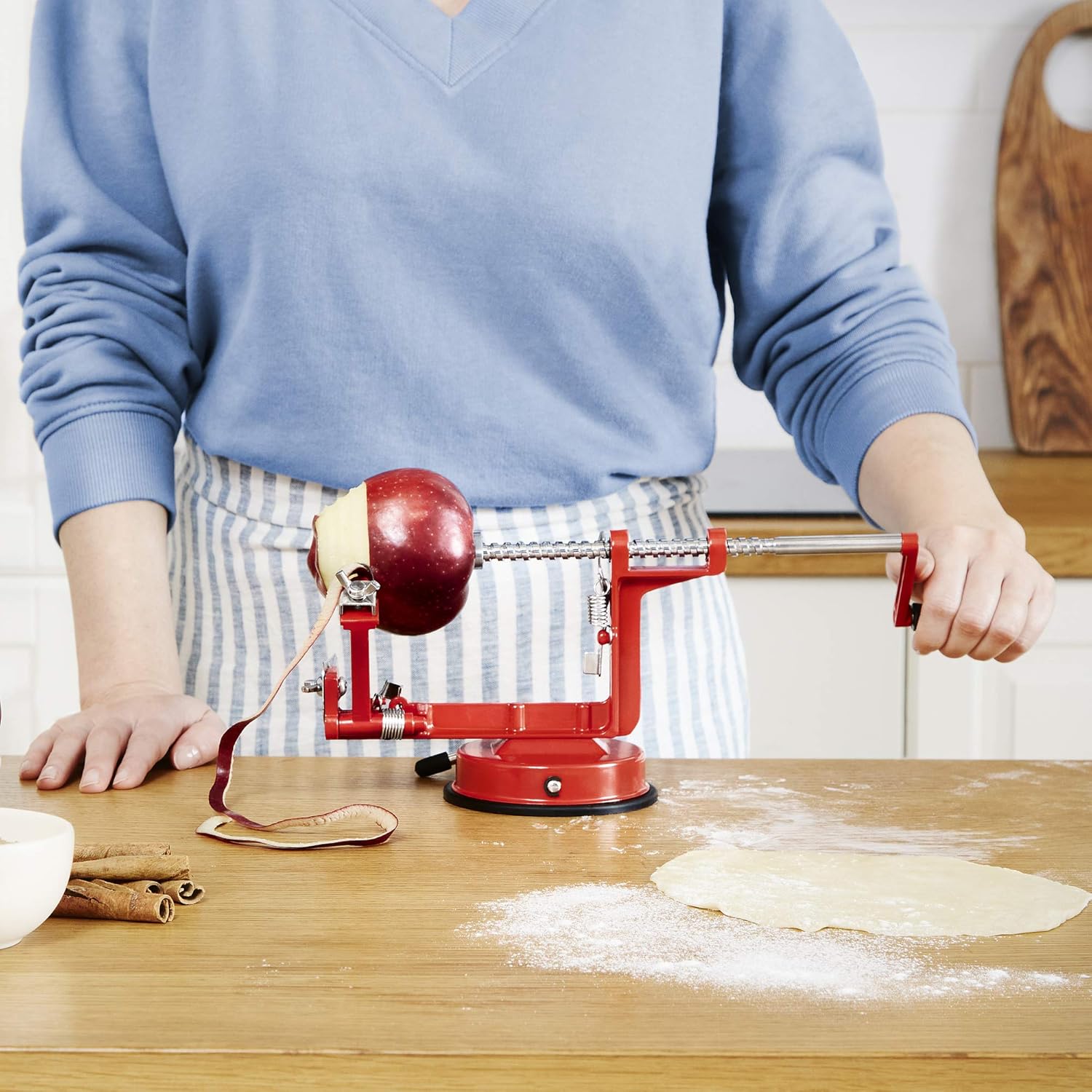
Side note about apple peelers: If you’ve never tried one of the red hand-crank apple peelers, and are skeptical about whether they work, I can say that they do work and I don’t want to be without one. They make quick work of slicing a large bunch of apples. Mine is low-end, purchased for $10 from the now-defunct Kitchen Collection stores. (I still miss Kitchen Collection stores!) I’m satisfied with the job my bargain version does. I’m guessing higher end versions attach more securely to the counter, or are made of higher quality metal, maybe? Just guessing. I’ve never tried one other than my own. Here’s one on Amazon that looks much like it. https://amzn.to/2WJcYJE (affiliate link)

Image from Amazon

Using the peels and cores: The apple cores and peels are not going to waste. I’m making Apple Scrap Vinegar. All it takes is the peels and cores, about 2 tablespoons of sugar per dozen apples, and some water. Let it ferment in a jar and you’ll have a handy vinegar with a nice apple scent. I use mine in laundry and some bathroom and kitchen cleaning. Full instructions for Apple Scrap Vinegar are here on this superb blog. https://zerowastechef.com/2014/10/30/apple-scrap-vinegar/


Switching gears from apples to music,… how about a song draft? I’m one of 13 participants in a 10-round song draft. My first two selections are here.

and here

But enough about my selections. We are two rounds into the draft, and what’s developing is a wonderful, diverse playlist. You can see all 26 of the selections so far here: